Tuesday, June 1, 2010

Some proposals from Brookings


This came across my desk this morning.

Titled "Econonic Growth and Institutional Innvotation: Outlines of a Reform Agenda," the policy monograph by William Galston discusses how our institutional design can affect our economy.

Galston starts from the premise that our economy is hampered by three deficits: fiscal (also known as the US budget deficit), savings (the lack thereof by US citizens) and investments.  He proposes that these be attacked by such things as Commissions that are insulated from the political process, yet still answerable to Congress.  Mandatory individual accounts added to Social Security.  And the creation of a "National Infrastructure Bank" funded with US tax dollars.  Such reforms would be impossible in our current climate, so institutional reforms that will empower centrists must be enacted.

To me, these are the more interesting suggestions: (1) replace the current system of having state legislatures draw political districts for themselves and the US House and (2) mandate voting.  I'll take a closer look at these ideas in some of my next posts.

Tuesday, May 25, 2010

Even more insane than I imagined...

As you'll recall, the agency that overseas safety at offshore drilling facilities, the Minerals Management Service (MMS) (an agency within the US Department of Interior) was structured in such a way as to create a conflict of interests.  In short, its funding came from the operations of the entities it was supposed to oversee from a safety perspective.  If your budget comes from an entity's operations, what are the odds you'll shut it down, even if you're concerned about safety?

This flaw was addressed rapidly as Secretary of the Interior Ken Salazar announced that MMS's collection and safety functions would be separated.

Today's Post contains the strongest evidence to date that the agency's conflict of interests created a situation where this situation was possible.  Amazingly, MMS officials' bonuses were tied to how meeting federal deadlines for leasing offshore oil and gas exploration, according to the Washington Post  Reports of environmental risks triggered reviews that delayed leases according to the story.

In short, the incentives for the individuals with oversight of the safety of offshore drilling facilities were paid based on how fast they could get drilling approvals done.

If this story is ever told in a productive manner it will be one of failed government design as much as anything else.

Wednesday, May 19, 2010

Yesterday's Elections


I'm not a political analyst, so I'll leave the analysis to others.  I'd just warn you that 90% of those who claim to be political analysts aren't very good at it, or have agendas other than providing the unvarnished truth.

Here are a few links for your consideration:

http://www.realclearpolitics.com/horseraceblog/

http://www.centerforpolitics.org/crystalball/

http://rothenbergpoliticalreport.blogspot.com/

http://www.cookpolitical.com/

Monday, May 17, 2010

The Financial Crisis Explained - Gambling With Other People's Money


Russ Roberts has made a career out of explaining difficult economic topics by relating them to ordinary life in a readable manner.  He explained why we should support free trade in The Choice and other economic concepts in several other novels that involve economic themes.

He's just issued a paper that explains the recent financial crisis very well.  You can download it here.

His critique is well balanced and very nuanced.  It covers all the bases to some degree, although it focuses most heavily on the problem he sees at the heart of the matter: government actions created a bailout expectation that led creditors to not act with their usual caution when it came to the housing market.  He partitions blame between the government and private actors who advocated the government's actions for personal gain.  I like that he takes a degree of personal responsibility, acknowledging that he had downplayed concerns about high leverage (ratio of debt to capital).  Most important, he rejects any easy, simplistic answers from the left (Wall Street Greed) or right (all due to Freddie and Fannie).

Here's just a very short "summary of the summary" to give you a taste:
In the United States we like to believe we are a capitalist society based on individual responsibility. But we are what we do. Not what we say we are. Not what we wish to be. But what we do. And what we do in the United States is make it easy to gamble with other people’s money—particularly borrowed money—by making sure that almost everybody who makes bad loans gets his money back anyway. The financial crisis of 2008 was a natural result of these perverse incentives. We must return to the natural incentives of profit and loss if we want to prevent future crises.
I don't agree with everything he says, this is probably one of the best pieces I've seen for those who aren't financial policy buffs but want to understand the connection between government activity and the economy a little bit better.

Thursday, May 13, 2010

The Inmates are Running the Asylum


The Washington Post's editorial page sounds a worried note after a conservative Republican lost his primary bid for not being quite conservative enough (i.e. he had voted for TARP and had co-sponsored a relatively moderate health care reform proposal with a Democrat) and a Democrat from West Virginia who had shown a willingness to compromise on greenhouse gas regulation lost as well.  In short, two fairly well respected Members who were willing to work with others on compromises lost to candidates who made it clear that compromise was not in their vocabulary:
For many party cleansers, working across party lines constitutes treason. We agree that elected officials ought to be guided by principles that they are willing to fight for. But we also see a difference between fidelity to principle and dogmatism. If Republicans cannot accept that Democrats may make some reasonable arguments, and vice versa, then nothing will get done
I normally don't blog on electoral politics, but this trend has obvious implications for governance if Members of Congress believe that the only way to keep their seats is to scream across the aisle rather than actually governing.  In future posts, I hope to look at what institutional reforms can be made to keep parties from becoming hostages to their most extreme elements.

Because, right now, the inmates are running the asylum in both parties.

Wednesday, May 12, 2010

The New Prime Minister


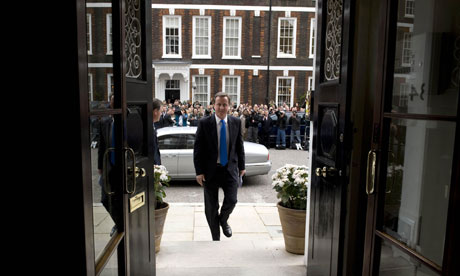
It hasn't taken as long as some feared for Britain to get a new government.  Conservative leader David Cameron and Liberal Democrat leader Nick Clegg have formed a coalition government (the first since the end of World War II apparently) between the two parties, with the Conservatives getting most of the leading offices given that they won the largest number of votes.  But Clegg will serve as the Deputy Prime Minister and several other top government posts will go to Liberal Democrat MPs.

Interestingly, one of their first moves will be to enact legislation fixing the term of Parliament at 5 years.  Under current law, a Parliament may last up to 5 years, but a Prime Minister may dissolve Parliament, thereby causing an election, earlier if he or she chooses.  The move may help to solidify the coalition (allaying Liberal Democrat fears that the Conservatives would call new elections once their polling looked better, gain a majority, and kick them out) but it also seems like good government (prohibiting a politically motivated call for a new election by the party in power for the purposes of political advantage.

Still, this could have profound effects on the entire British political system, and render it looking much more like that of the U.S. in several ways.

For example, suppose the Prime Minister loses the majority.  Would Britain be stuck with a prime minister who lacks majority support in the Parliament?  If so, it could come to resemble the US system, where the President and Congress frequently do not come from the same party, a little bit more.

More importantly, it would also likely end the tradition of short, inexpensive campaigns because candidates will know exactly when the elections will be and can start campaigning earlier than the usual 30 day window from when the PM announces an election and when it takes place.  Such a change may wind up with very profound effects.  As a result of longer, more expensive campaigns, voters may wind up paying less attention and fewer going to the polls.

Tuesday, May 11, 2010

Learning the Right Lessons Part II


Learning the right lessons from a failure is the first step towards improving future performance, in life, in business and especially in government.  As we discussed earlier, the most important aspect of the government's oversight of the safety of offshore drilling rigs may have been the merger of two conflicting tasks, safety and revenue collection, in the same agency.

The AP is now reporting that the administration is looking into splitting the Minerals Management Services into two different agencies centered around these very different tasks.  As we learned last week, the British took a similar step years ago, and improved their safety record as well.  Even if the Wall Street Journal didn't seem to get it quite right when it wrote its headline, Department of Interior Ken Salazar seems to understand.